
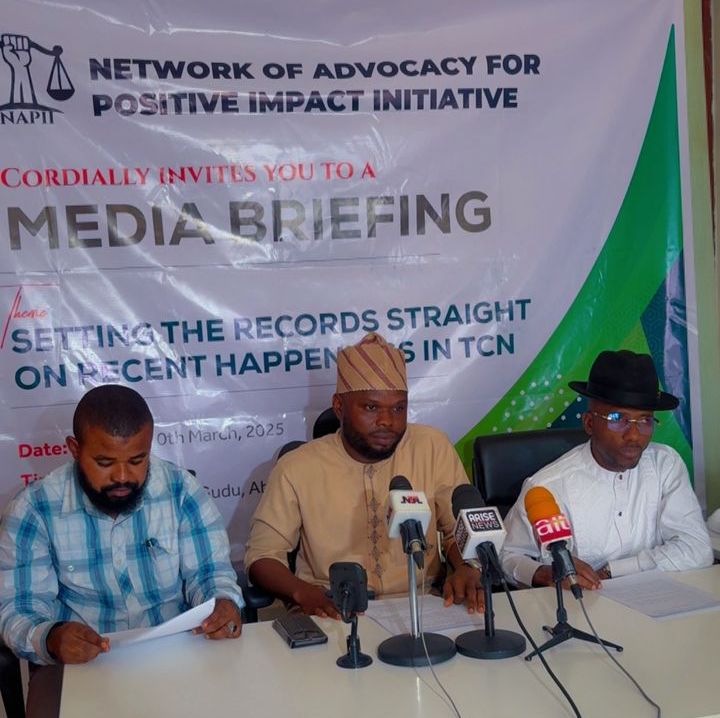
The Network of Advocacy for Positive Impact Initiative (NAPII) has called for restraint, responsible engagement, and evidence-based public discourse in addressing allegations currently circulating about the operations and leadership of the Transmission Company of Nigeria (TCN).
Speaking at a media briefing in Abuja on Monday, the Executive Secretary of NAPII, Comrade William Smith Bassey, said the organization convened the briefing to clarify issues and prevent misinformation capable of undermining public confidence in one of Nigeria’s most critical infrastructure institutions.
According to Bassey, while citizens, labour organizations, and stakeholders have the constitutional right to raise concerns about public institutions, such engagements must be guided by fairness, responsibility, and respect for due process.
He emphasized that the nation’s electricity transmission network plays a strategic role in Nigeria’s power sector, serving as the crucial link between electricity generation companies and distribution companies across the country.
“The electricity transmission system remains the backbone of Nigeria’s power supply architecture. Any narrative that seeks to undermine confidence in this vital institution must therefore be carefully examined to ensure that public discourse remains factual, balanced, and in the national interest,” he stated.
NAPII explained that its decision to address the matter publicly was informed by what it described as sweeping allegations currently circulating in sections of the media concerning TCN’s operations.
The organization noted that after reviewing the claims, many appeared to rely on broad generalizations rather than concrete evidence.
Bassey stressed that government institutions such as TCN operate within established administrative and regulatory frameworks that provide oversight and accountability mechanisms.
He pointed out that institutions like the Federal Ministry of Power and other regulatory bodies exist specifically to ensure transparency, compliance with procurement rules, and adherence to due process in public sector management.
“Matters relating to procurement, operational policies, and management decisions within government institutions are governed by laid-down procedures. Where concerns exist, these should be channelled through the appropriate authorities rather than presented in ways that may create unnecessary tension in a critical sector like power,” he added.
The advocacy group also highlighted the complex nature of Nigeria’s transmission infrastructure, noting that transmission assets are spread across vast and often challenging terrains nationwide.
According to NAPII, these realities sometimes require emergency responses and technical interventions to maintain stable electricity transmission across the national grid.
Bassey further noted that at a time when the Federal Government is working to strengthen grid stability, expand transmission capacity, and improve power supply to support economic growth, it is essential that stakeholders avoid narratives capable of distracting institutions from their core mandate.
He advised that organizations or individuals with concerns about the operations of TCN should make use of existing institutional mechanisms to seek clarification, including requesting relevant budgetary information and operational details through appropriate channels.
“Every organization has internal structures and oversight systems for addressing issues of this magnitude. Information regarding budget approvals by the National Assembly and releases to agencies is publicly documented and accessible through proper processes,” he said.
The advocacy group expressed confidence in the current management of TCN and urged stakeholders to support the institution as it works to improve electricity transmission nationwide.
According to NAPII, national institutions that play a central role in the functioning of the economy must be supported and constructively scrutinized through responsible channels rather than weakened by what it described as “wild allegations” capable of distorting public perception.
“The Transmission Company of Nigeria has been working round the clock to ensure the safe and efficient delivery of electricity to Nigerian homes. What is required at this time is a patriotic approach by all stakeholders to support the success of its mandate,” Bassey said.
NAPII reaffirmed its commitment to promoting transparency, responsible advocacy, and balanced engagement on issues affecting Nigeria’s development, while also commending members of the media for their role in sustaining informed public discourse.
The organization concluded by urging journalists and stakeholders to continue prioritizing accuracy, fairness, and national interest when reporting on matters relating to critical sectors of the economy.